UnitedHealth Q2 2026 Earnings Insight Report
This UnitedHealth Q2 2026 earnings report is a HealthWorks AI breakdown of UnitedHealth Group's Q2 2026 earnings call and results, covering Medicare Advantage, Medicaid, and Optum performance.
Section 1
Executive summary: the UnitedHealth Q2 2026 earnings takeaways
UnitedHealth Group's Q2 2026 earnings release was a clean, straightforward beat, a stark contrast to the reserve-dependent story the company told after Q1. Adjusted earnings per share came in at $6.38, up from $4.08 a year ago, and the company raised its full-year 2026 adjusted EPS guidance for the second time this year, to $19.50–$20.00, up from the at-least-$18.25 floor it set after Q1. Revenue grew a modest 0.4% to $112.0 billion, but earnings from operations jumped 55% to $8.0 billion, and the improvement showed up broadly: UnitedHealthcare's operating margin nearly doubled to 4.6%.
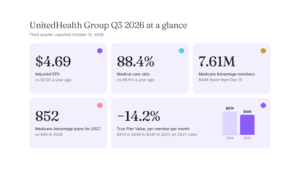
The membership story keeps moving in the opposite direction, on purpose. Medicare Advantage membership fell 9.4% year-over-year to 7.6 million, Medicaid fell 9.5% to 6.8 million, and management now expects the full-year Medicare Advantage decline to land near 1.1 million, an improvement on the 1.3 million originally guided after Q1. UnitedHealth remains the largest Medicare Advantage health plan in the country and the largest Medicare Supplement health plan through its AARP-branded plans, so it is shrinking from a position of scale, not weakness, and pricing for margin rather than defending share.
One thing to watch
One area where this quarter doesn't fully back up the clean-beat narrative is the medical care ratio. At 86.7%, it was still aided by $860 million of favorable prior-period reserve development, the same tailwind flagged as a fading risk after Q1. This figure also landed above the mid-80s range the company's own prior guidance had set as the real test of underlying margin recovery.
See the full promise-vs-delivery scorecard below for exactly where this UnitedHealth Q2 2026 earnings report delivered on its promises and where it fell short, or jump straight to what this means for your plan.
Section 2
Did they deliver on what they promised last quarter?
Measured against the commitments and watchlist items from HealthWorks AI's Q1 2026 UnitedHealth Group analysis, reported April 21, 2026.
| What they promised in Q1 2026 | What actually happened in Q2 2026 | Verdict |
|---|---|---|
| Medicare Advantage full-year membership declines to "center around 1.3 million" | CFO now guides to approximately 1.1 million for the full year, a smaller decline than originally forecast | Delivered, improved |
| Medicaid margins stay negative through 2026, with modest improvement starting 2027 | Margins tracking to -1% to -1.7% for the year, as guided; no change to the 2027 recovery framing | On track |
| Q2 MCR framed as the cleanest test of underlying margin recovery without reserve and seasonal tailwinds, targeting a mid-80s range | Actual Q2 MCR was 86.7%, above that target range, and still included $860 million of favorable prior-period development, the same tailwind Q1 said would fade | Off track |
| Minimum $2 billion in share buybacks by the end of Q2 2026 | The six-month cash flow statement shows $1.6 billion in repurchases through June 30; the company separately cites $4.0 billion repurchased through mid-July, a period running past the quarter-end commitment | Mixed |
| $1.5 billion AI investment in 2026, targeting a 2:1 return within 12 to 18 months | Confirmed as ongoing; no updated return metric was disclosed this quarter | Pending |
This UnitedHealth Q2 2026 earnings scorecard shows two of five commitments as clean, on-plan deliveries, and the Medicare Advantage membership forecast actually improved. The medical care ratio is the one that matters most, still leaning on the same fading reserve tailwind flagged after Q1, and the buyback pace and AI return metric are both still open questions heading into Q3.
Section 3
What's actually changing
The beat is broader than the reserve benefits this time
Q1's margin story leaned heavily on a one-time reserve benefit; Q2's 55% jump in operating earnings shows up across every segment, not just one favorable adjustment.
Medicare Advantage membership decline is moderating, not deepening
The full-year forecast improved from 1.3 million to 1.1 million between Q1 and Q2, evidence that benefit changes are landing roughly as modeled rather than triggering unexpected member flight.
Optum Health's turnaround has legs
Profit nearly tripled year-over-year (up 177.4%) even as the segment served fewer value-based care patients, pointing to real operational and clinical cost management rather than volume growth.
The Medicaid exit pattern is spreading beyond one state
Community and State membership fell by 380,000 in the quarter, which the company attributes to the planned Louisiana health plan exit combined with ongoing Medicaid eligibility redeterminations (UnitedHealth has not broken out the Louisiana-only figure separately). It is part of a pattern Becker's Hospital Review described as UnitedHealthcare's "deliberate trade-off" for margin recovery, plan-level Medicaid retrenchment ahead of 2027 state rate cycles.
The margin-over-volume test has yet to be fully proven
The medical care ratio still depends on favorable reserve development that was expected to fade, so the underlying trend is better than Q1 but not yet proven clean.
Section 4
Key leadership quotes
All quotes below are verbatim from the Q2 2026 earnings call transcript.
“We now expect full-year Medicare Advantage enrollment to decline by approximately 1.1 million and Medicare margins to finish 2026 above 3%.”
What this really means: this comes directly from the executive who owns the P&L, confirming the improved-from-1.3-million framing and locking management into a specific margin target it will now be held accountable to.
“Overall, our 2026 margins will be within our previously communicated range, as you've indicated, -1% to -1.7%, and we expect to hit that expectation for the year.”
What this really means: management is holding the line on the same negative range guided after Q1, confirmation rather than a surprise in either direction.
“Our reported medical care ratio of 86.7% includes $860 million of net favorable prior period medical development, the majority of which is in-year development.”
What this really means: management itself is naming the exact tailwind that kept this quarter from being a truly clean test of underlying margin recovery, the same tailwind flagged as a fading risk after Q1.
“We are seeing positive momentum across Optum, with all three business segments performing in line or ahead of plan through the first half of the year.”
What this really means: a broader claim than the Optum Health profit jump alone suggests — management is framing all three Optum units as ahead of plan, not just the one with the headline number.
“We now expect to complete total share repurchases of at least $5 billion in 2026, compared to initial guidance of $2.5 billion.”
What this really means: doubling the buyback target signals confidence in cash generation, even though the actual pace through Q2 lagged the earlier $2 billion-by-Q2 framing.
“I don't ever believe I ever didn't believe in the 13%–16% long-term growth rate.”
What this really means: a direct, somewhat defensive reaffirmation of the company's long-standing growth algorithm, aimed squarely at investors who questioned it after a rocky prior year.
Section 5
Where the guidance goes from here
Section 6
How the competitive picture is shifting
- UnitedHealth remains the largest Medicare Advantage health plan nationally, with the widest reach across metro markets, but its Medicare Advantage decline (down 9.4% year-over-year) and shrinking national share point to the same margin-over-volume trade seen elsewhere in the industry this quarter, not a company-specific retreat.
- The Louisiana Medicaid exit is a concrete, near-term displacement event. Expect it to be one of several state-level Medicaid exits industry-wide as plans reassess ahead of 2027 rate negotiations.
- UnitedHealth's Optum Insight AI push, including the newly closed Alegeus acquisition, signals it intends to compete on cost and data infrastructure, not just enrollment, a dimension worth watching even for plans that don't compete with UnitedHealthcare directly on membership.
Section 7
What this means for your plan
If you compete in overlapping MA counties
The margin-over-volume posture, improving from a 1.3 million to a 1.1 million forecasted decline, still leaves displaced-member opportunity heading into 2027 AEP, if your own pricing and Star ratings can absorb it profitably.
If you operate a Medicaid book in Louisiana or the Gulf South
Begin scenario planning now for membership and network impact from the exit, the same way any large health plan's state-level Medicaid withdrawal should be tracked.
If you're benchmarking medical cost trend
UnitedHealth's continued reliance on favorable prior-period development, even after flagging it as a fading tailwind last quarter, suggests underlying utilization trend across the industry may be firmer than headline medical care ratio improvements imply.
If you're evaluating your own AI or automation roadmap
UnitedHealth's $1.5 billion committed spend and 12–18 months payback target is a real external benchmark for what disciplined AI investment looks like in this market.
Client-specific implications: Beyond the general industry read, this quarter carries direct account-level implications. The Louisiana Medicaid exit, part of a 380,000-member Community and State decline this quarter (combined with eligibility redeterminations, not isolated to Louisiana in UnitedHealth's own disclosure), creates a concrete opening for clients operating in that market or adjacent Gulf South states. More broadly, the continued Medicare Advantage contraction nationally means clients in UnitedHealthcare's higher-share metro markets should expect inbound member interest sooner rather than later and may see unexpected enrollment gains they should be prepared to service.
How our clients can use HealthWorksAI to act on this
This is exactly the kind of shift our platform is built to quantify before it shows up in enrollment reports. Clients can run SAE/SAR analysis for both Medicare Advantage and Medicaid to see precisely which counties and service areas UnitedHealth is contracting in, use disruption analysis to model provider network overlap and exposure the way we have for other carrier exits, pressure-test enrollment predictions against UnitedHealth's improving-but-still-declining membership trend, and pull a market snapshot to see where the displaced-member opportunity is real versus where it is already being contested by other competitors.
Section 8
What to watch next quarter
| Q3 MCR | Does it hold near the current range without further reserve-development support, the real test of whether Q2's clean-beat framing holds up. |
| MA membership | Whether the Medicare Advantage full-year decline lands at or below the revised 1.1 million forecast, or drifts back toward the original 1.3 million. |
| Medicaid exits | Whether additional state Medicaid exits are announced beyond Louisiana ahead of 2027 rate cycles. |
| Q3 buybacks | Share repurchase pace, to see whether the company closes the gap toward its at-least-$5.0-billion full-year target after a slower first half. |
| AI ROI | Any disclosed update on the AI investment's return metrics, since none was given this quarter despite the spend continuing. |
Want this report as a PDF?
Download the full UnitedHealth Group Q2 2026 Earnings Insight report to save, print, or share with your team.
Download PDF