Introduction
The Medicare Advantage winners losers 2026 story is one of share redistribution rather than broad-based expansion. The MA market continues to evolve as policy changes, reimbursement pressures, and competitive dynamics reshape enrollment trends across major payers. While the market remains highly concentrated among a few national insurers, recent data following the 2026 Centers for Medicare & Medicaid Services (CMS) Annual Enrollment Period (AEP) reflects this shift decisively. Drawing on CMS Landscape, Enrollment, Plan Benefit Package (PBP), and crosswalk files, this analysis examines enrollment changes between December 2025 and February 2026 to identify early AEP winners and losers and the factors driving these shifts.
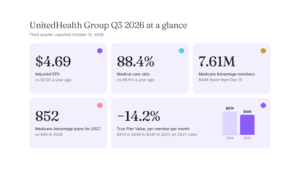
Despite experiencing a modest enrollment decline, UnitedHealth Group remains the largest MA sponsor with more than 7.6 million members, with its Medicare Advantage market share 2026 declining from 27.8% to 25.8%. In contrast, Humana posted strong growth, adding more than 1 million members year over year (YoY), reflecting continued strength in its MA-focused strategy, broker distribution, and benefit competitiveness. At the same time, emerging and regional insurers such as Devoted Health, SCAN Group, and Alignment Healthcare continued to capture share through targeted geographic expansion and differentiated plan offerings, reinforcing their role as disruptive challengers in the MA landscape.
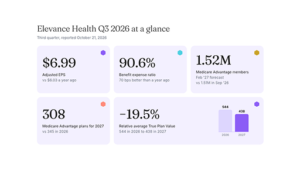
Conversely, several large incumbents experienced early-year enrollment contraction. Alongside UnitedHealth Group, CVS Health and Elevance Health recorded net membership declines between December and February, reflecting a combination of competitive pressures, benefit adjustments, star rating changes, and evolving federal payment policies.
This analysis further examines each organization's plan portfolio, enrollment composition, plan types (including Special Needs Plans), and geographic penetration, alongside state- and county-level enrollment patterns. It also evaluates cost factors like premiums, drug coverage segments, maximum out-of-pocket (MOOP) limits, benefit distribution, and the influence of CMS Star Ratings, providing a comprehensive view of how benefit design, quality performance, and market strategy are shaping MA enrollment outcomes in the early months of the 2026 plan year.
UnitedHealth saw its share decline by about 2%, while Humana increased its share by nearly 3 percentage points, growing membership from 5.2M to 6.24M. Health Care Service Corporation (HCSC) expanded its share by roughly 2% following the acquisition of Cigna's MA business. Meanwhile, disruptor Devoted Health more than doubled its membership, highlighting continued growth among emerging MA players, and SCAN recorded 40% YoY growth.
Medicare Advantage Winners Losers 2026 — Enrollment & Competitive Shifts
Enrollment levels, market share, growth rates, and plan portfolio strategies together reveal a reshaping competitive hierarchy among major MA insurers. The Medicare Advantage winners losers 2026 analysis shows UnitedHealth Group remaining the largest payer with 7.64M members, though its share slipped to 25.8% as it lost ~725K members — even while maintaining a large portfolio of 846 plans after trimming offerings from its 2025 peak. In contrast, Humana delivered the strongest rebound, adding ~1.03M members (20% YoY growth) and expanding its share to 21.1%, while growing its footprint to 887 plans — the largest portfolio among peers.
CVS Health remained relatively stable at ~2.7M members (~9% share) but reduced its plan offerings from 742 in 2024 to 642 in 2026, signaling a more selective strategy. Elevance Health experienced the steepest contraction, losing ~318K members and declining to 5.1% share, while maintaining a relatively steady plan portfolio.
At the same time, fast-growing challengers are rapidly scaling both membership and product presence. Devoted Health expanded from 60 plans in 2022 to 427 in 2026 and more than doubled membership to ~456K (119.7% growth), while SCAN Group surpassed 426K members (44.5% growth) with a stable but targeted plan lineup. Together, these shifts illustrate a market where growth is increasingly captured by focused, high-growth disruptors and selective incumbents, while several established players face slowing momentum or portfolio rationalization.
25.8% Share (was 27.8%)
+20% YoY Growth
60 → 427 Plans
294K → 426K Members
| Parent Organization | 2022 | 2023 | 2024 | 2025 | 2026 |
|---|---|---|---|---|---|
| UnitedHealth Group | 6,221,097 | 6,966,906 | 7,448,634 | 7,970,694 | 7,639,358 |
| Humana Inc. | 4,500,844 | 5,004,872 | 5,482,601 | 5,197,950 | 6,240,192 |
| CVS Health | 1,956,858 | 2,081,403 | 2,690,899 | 2,799,617 | 2,724,507 |
| Elevance Health | 1,668,507 | 1,756,378 | 1,692,013 | 1,890,615 | 1,518,973 |
| Devoted Health | 71,400 | 122,985 | 200,777 | 207,401 | 455,626 |
| SCAN Group | 268,130 | 280,691 | 275,113 | 294,922 | 426,130 |
| Parent Organization | 2023 | 2024 | 2025 | 2026 |
|---|---|---|---|---|
| UnitedHealth Group | +302,794 | −21,296 | +492,630 | −724,949 |
| Humana Inc. | +472,362 | +107,369 | −432,319 | +1,032,249 |
| CVS Health | +13,794 | +544,621 | −256,292 | −141,010 |
| Elevance Health | +37,137 | −54,172 | +173,380 | −318,278 |
| Devoted Health | +41,047 | +59,980 | −35,874 | +249,137 |
| SCAN Group | +9,897 | −7,697 | +18,750 | +114,669 |
Plan Portfolio Size — Expansion vs Rationalization
| Parent Organization | 2022 | 2023 | 2024 | 2025 | 2026 |
|---|---|---|---|---|---|
| Humana Inc. | 750 | 823 | 789 | 794 | 887 |
| UnitedHealth Group | 735 | 822 | 888 | 923 | 846 |
| CVS Health | 577 | 621 | 742 | 697 | 642 |
| Devoted Health | 60 | 127 | 145 | 235 | 427 |
| Elevance Health | 382 | 397 | 376 | 382 | 345 |
| SCAN Group | 53 | 66 | 85 | 65 | 74 |
Medicare Advantage Winners Losers 2026 — Plan Description Mix
The comparison between 2025 and 2026 shows a clear shift from consolidation to renewals and selective growth. In 2025, players like SCAN Group had a high share in consolidated plans (32.3%), which dropped to 6.8% in 2026, indicating consolidation efforts were largely completed. At the same time, renewal focus increased significantly — UnitedHealth Group reduced new plans (139 to 32) while boosting renewals to 76.2%, and Humana increased renewals from 49.0% to 58.2%, highlighting a strong industry-wide move toward retention.
Some players are taking a different approach. Devoted Health emerges as the most aggressive growth player, increasing its new plan share from 21.3% to 33.0%, while Humana significantly scales expansion by increasing its new plan count from 91 to 192 — the highest among all payers. CVS Health remains balanced, with stable new plan contribution but increased consolidation (5.6% to 9.0%) and higher adoption of SAR-based renewals.
Meanwhile, Elevance Health is diversifying its mix, reducing reliance on traditional renewals (303 to 228) while shifting toward SAR and initial contracts, indicating a more flexible strategy. For deeper analytics on payer portfolio shifts, explore HealthWorksAI's Medicare Advantage analytics platform.
| Organization | Consolidated | Initial Contract | New Plan | Renewal Plan | w/ SAE | w/ SAR |
|---|---|---|---|---|---|---|
| CVS Health | 5.6% | 0.0% | 19.9% | 41.9% | 11.0% | 21.5% |
| Devoted Health | 1.7% | 20.9% | 21.3% | 36.6% | 17.0% | 2.6% |
| Elevance Health | 3.9% | 0.0% | 8.9% | 79.3% | 5.8% | 2.1% |
| Humana Inc. | 2.9% | 0.5% | 11.5% | 49.0% | 4.0% | 32.1% |
| SCAN Group | 32.3% | 0.0% | 15.4% | 49.2% | 3.1% | 0.0% |
| UnitedHealth Group | 3.4% | 0.2% | 15.1% | 65.5% | 8.1% | 7.7% |
| Organization | Consolidated | Initial Contract | New Plan | Renewal Plan | w/ SAE | w/ SAR |
|---|---|---|---|---|---|---|
| CVS Health | 9.0% | 0.0% | 19.0% | 43.0% | 4.2% | 24.8% |
| Devoted Health | 0.5% | 14.1% | 33.0% | 28.3% | 23.7% | 0.5% |
| Elevance Health | 5.2% | 3.2% | 9.0% | 66.1% | 6.4% | 10.1% |
| Humana Inc. | 6.2% | 0.2% | 21.6% | 58.2% | 4.3% | 9.5% |
| SCAN Group | 6.8% | 2.7% | 17.6% | 63.5% | 9.5% | 0.0% |
| UnitedHealth Group | 0.4% | 0.9% | 3.8% | 76.2% | 5.8% | 12.9% |
Medicare Advantage Winners Losers 2026: Plan Types — HMO & PPO Drive Humana's Growth
Humana's growth was driven primarily by Local PPO and Local HMO plans, each reaching about 3 million members in 2026. Local PPO plans recorded the fastest growth, adding 562.7K members (27% YoY) and expanding plan offerings from 360 to 435, increasing their share to 48.8%. Local HMO plans also grew, adding ~490K members with plan count rising from 391 to 412, though their share declined slightly to 49.8% as PPOs expanded faster. Together, HMO and PPO plans now account for nearly the entire portfolio with roughly 50% share each. Meanwhile, PFFS and Regional PPO segments declined, and MMP plans phased out, reflecting a continued shift toward more flexible PPO structures. Humana's enrollment is heavily concentrated in Florida, leading with ~684.7K Local HMO and ~426.9K Local PPO members. Smaller segments include PFFS in Georgia (~6.8K) and Regional PPO in Texas (~10.9K).
+27% YoY
391 → 412 Plans
of Humana Portfolio
2025 → 2026
Geographic Concentration — Humana's State-Level Growth
Humana's enrollment changes were largely driven by growth in a few key states while declines occurred in smaller markets. Florida remained the largest market with ~1.12M members, adding ~114K members, followed by Texas with ~79K net gains and Georgia and Illinois contributing ~47.6K and ~54.6K AEP gain, respectively. Missouri recorded the fastest growth rate with a 74% YoY increase (~61.4K members), while North Carolina saw moderate expansion. In contrast, declines were concentrated in Minnesota losing ~8.0K members, while Puerto Rico, South Dakota and North Dakota saw complete enrollment exits. Humana holds the leading enrollment position across 14 states, with its strongest presence in Florida (~1.29M members) and North Carolina (~712.5K). Other major markets include Illinois (~502.5K) and Georgia (~419.0K). Overall, Humana's dominance is concentrated primarily across the Southeast and parts of the Midwest, where it leads enrollment in states such as Alabama, Kentucky, Tennessee, and Louisiana.
Largest Single Market
Fastest Growth State
Holds #1 Position
PR, SD, ND
Cost Strategy — The $0 Premium Shift
Humana's portfolio has shifted decisively toward $0 premium plans, which grew from 376 plans in 2022 to 683 in 2026 and now account for 77% of all plan offerings. Enrollment in these plans also rose sharply from 2.84M to 5.49M, showing that growth has been concentrated in zero-premium products. In contrast, higher-premium segments steadily contracted, with both plan counts and enrollment declining across nearly all bands above $25, indicating a clear strategy toward lower-cost, more competitive offerings.
are $0 Premium
(was 376 in 2022)
(was 2.84M in 2022)
Declining Above $25
County-Level Footprint — Optimization Over Broad Expansion
Humana maintained a broad geographic presence in 2026, operating across 2,657 counties while exiting 199 counties and entering 5 new ones. The portfolio saw notable restructuring, with 194 new plans launched compared to 39 terminated plans, alongside 257 service area expansion (SAE) plans and 124 service area reduction (SAR) plans at county level. These changes impacted approximately 114.2K members, including 22.5K lives affected by payer exits, reflecting ongoing adjustments to optimize market coverage and plan offerings.
in 2026
vs 5 New Entries
vs 39 Terminated
22.5K from Payer Exits
"Growth is increasingly captured by focused, high-growth disruptors and selective incumbents — while several established players face slowing momentum or portfolio rationalization."
Medicare Advantage Winners Losers 2026 — What the Redistribution Means for 2027
The 2026 Medicare Advantage AEP reinforces a clear bifurcation in the market. Humana's breakout year — driven by aggressive $0 premium expansion, a growing plan portfolio of 887 plans, and disciplined geographic concentration across the Southeast and Midwest — demonstrates that focused execution can deliver significant share gains even in a moderating enrollment environment. Devoted Health and SCAN Group confirmed that the challenger tier is maturing, with both carriers rapidly scaling membership and plan count to challenge legacy incumbents.
On the other side, UnitedHealth Group's 725K member decline and Elevance Health's 318K loss reflect the compounding pressures of benefit adjustments, star rating changes, and the heightened cost of competing against zero-premium alternatives. CVS Health's selective portfolio rationalization — reducing plan count from 742 to 642 — signals a measured approach to defending share rather than expanding it.
The Medicare Advantage winners losers 2026 redistribution is structural, not cyclical. Carriers that align benefit competitiveness, broker relationships, and geographic focus will continue to capture disproportionate share. The momentum favors the focused challengers — and incumbents will need to respond with comparable speed and precision in 2027.