Be the first to read our insights
Get the latest Medicare Advantage, Medicaid, and Marketplace intelligence delivered straight to your inbox, and download this report as a PDF.
Thanks! Your download should start now. If it doesn't, open the PDF here.
CVS Health Q3 2026 earnings: a broad beat and a raised outlook, as CVS plans to split into two companies
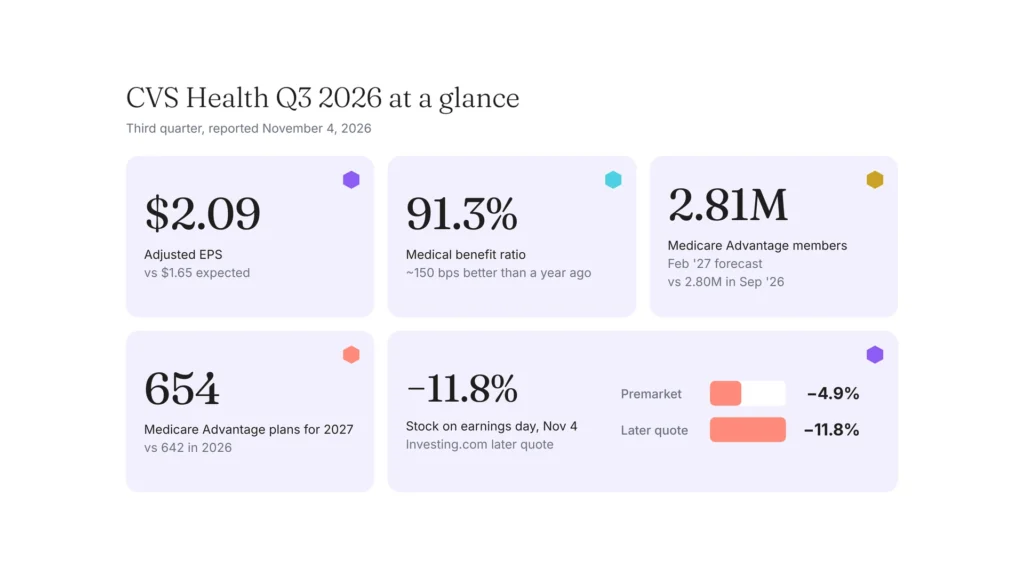
CVS Health reported adjusted EPS of $2.09 against $1.65 expected, raised its 2026 outlook to at least $8.20, and announced plans to separate into two public companies by the first half of 2028. It also filed 654 Medicare Advantage plans for 2027, up from 642, while exiting 127 counties. This page reads the earnings call, the stock reaction and HealthWorksAI's 2027 plan, benefit and enrollment data together.
Section 1
Executive summary: CVS Health Q3 2026 earnings takeaways
CVS Health's Q3 2026 results beat expectations and extended a run of eight straight quarters of beating and raising guidance. Adjusted EPS was $2.09 against $1.65 expected, up more than 30% from a year ago, and revenue was $108.4 billion against $104.75 billion expected. Health Care Benefits adjusted operating income rose by nearly $600 million to about $900 million, and the medical benefit ratio improved by about 150 basis points to 91.3%, driven by Medicare. Management raised 2026 adjusted EPS guidance to at least $8.20 from $7.90 to $8.10, and set a 2027 floor of at least $8.65, about 13% growth off an adjusted 2026 baseline. Even so, shares fell, down 4.9% in premarket trading to $86.95 and about 11.8% on Investing.com's later quote, with attention turning to the separation and to a trough year for Health Services in 2027.
Separately, CVS announced its intention to separate into two independent publicly traded companies, expected to be completed in the first half of 2028 as a tax-free transaction. CVS Health, led by David Joyner, would keep Aetna, Caremark and pharmacy services, specialty pharmacy, Oak Street and Signify Health, while CVS Pharmacy, led by Prem Shah, would hold the retail stores, mail order, MinuteClinic and the Health100 platform. Management said both companies are expected to carry solid investment-grade balance sheets and that share repurchases resume in the fourth quarter. For 2027 it expects Health Services adjusted operating income of at least $7 billion, a trough year, and Aetna said Medicare Advantage moves into profitable territory in 2026, with another year of margin improvement and modest growth planned.
Despite broader Medicare Advantage plan reductions across the market, CVS expanded from 642 to 654 plans for 2027 while entering 60 counties and exiting 127, so the growth is concentrated in fewer places, with Texas and Missouri each adding eight plans and Florida losing four. HealthWorksAI's relative True Plan Value™ (TPV) rose 6.4% to $546.5 after two years of decline, about 11% above the $494 average across the 20 largest payers by total plan count, led by supplemental benefits (up $20.7 to $70.7) and Part D (up $16.3 to $336.2). Plans in the top $700 drug deductible tier fell to 409, or 62.5% of plans, from 538, or 83.8%, in 2026, and only 9 plans keep a $0 deductible. Aetna described benefit adjustments as one of several levers for 2027 margin, but our data points to value shifting toward Part D and supplemental benefits as the footprint narrows. HealthWorksAI's enrollment forecast projects 2,805,837 Medicare Advantage members by February 2027, essentially flat from 2,803,713 in September 2026, consistent with management's expectation of modest growth. Overall, our analysis suggests CVS is pruning counties to protect margin while using richer benefits to hold the members it keeps, so the key test is whether AEP retention supports the planned margin gains.
1. Earnings
Adjusted EPS, third quarter
Outlook raised to at least $8.20, from $7.90 to $8.10. Revenue was $108.4B, ahead of the $104.75B expected.
2. Medical benefit ratio
Share of premiums paid out as medical costs, Health Care Benefits
About 150 basis points better than a year ago, driven by Medicare. Axis 86% to 92%, lower is better.
3. Where earnings come from
Q3 adjusted operating income by segment, $ billion
Health Care Benefits rose by nearly $0.6B from a year ago. Consolidated adjusted operating income was $4.2B. Bar scale is $0 to $2.5B.
4. The 2027 plan map
CVS Medicare Advantage plans in its three largest states, 2026 to 2027
20262027
654 plans against 642, with 60 counties entered and 127 exited. Scale 0 to 70 plans.
HealthWorksAI enrollment forecast
CVS Medicare Advantage members, thousands, HealthWorksAI enrollment data and forecast
+2,124
Essentially flat: 2,805,837 members forecast by February 2027, from 2,803,713 in September 2026. Management expects modest Medicare Advantage growth in 2027.
5. True Plan Value™
HealthWorksAI's proprietary measure of benefit value. Relative average across CVS plans
+6.4%
CVS's relative average True Plan Value™ rises 33.0 points across its 654 plans for 2027, to $546.5, after falling in 2025 and 2026. It remains about 13% below 2024.
6. Stock reaction
CVS on earnings day, November 4, 2026
Premarket $86.95 against a $91.41 prior close. The later reading is Investing.com's live quote.
52-week range $69.51 to $110.68. Premarket sat about 42% of the way up from the low, against about 53% at the prior close.
Section 2
Key leadership commentary
The commentary below summarizes statements on CVS Health's Q3 2026 earnings call, with one short verbatim phrase. The interpretations are ours.
On the quarter
Earnings grew in every operating segment and adjusted EPS rose by more than 30%. With 2026 guidance now more than $1 above the initial outlook, management said it can announce a separation from a position of strength.
David Joyner, Chairman and Chief Executive Officer, CVS Health
What this really means: the beat was broad but Medicare-led. Health Care Benefits earnings rose by nearly $600 million and the ratio improved by about 150 basis points, with Medicare modestly ahead of plan on cost management and pricing. The harder question for investors is 2027, where the $8.65 floor implies growth of about 13% and Health Services is set to trough.
On the separation
CVS Health keeps the businesses where integration matters, including Aetna, Caremark, specialty pharmacy, Oak Street and Signify, while CVS Pharmacy becomes the national retail pharmacy and community healthcare company. Retail has operated behind a firewall for two decades, so commercial agreements can replace internal integration.
David Joyner, Chairman and Chief Executive Officer, CVS Health
What this really means: the split is framed as focus and capital allocation, not distress, with both companies expected to be investment grade and dis-synergies described as manageable. The process runs 15 to 18 months, so expect more detail on the commercial agreements between CVS Pharmacy and Caremark and Aetna.
On Health Services in 2027
“…2027 will reflect trough earnings for the segment.”
Brian Newman, Chief Financial Officer, CVS Health
What this really means: management set a floor of at least $7 billion for Health Services adjusted operating income in 2027, which already absorbs a decline in 340B earnings and lower Caremark membership. The offsets are specialty pharmacy strength and a second year of improvement in the healthcare delivery business, including Oak Street.
More from the call
On Medicare Advantage
Medicare moves into profitable territory in 2026, ahead of expectations. For 2027 Aetna priced for elevated trend and pulled several levers: benefit adjustments, geography, product mix, leading Star scores, network changes and medical cost management. Early AEP is playing out as expected, with modest growth planned.
Steve Nelson, Aetna President
On 2027 guidance
Adjusted EPS of at least $8.65 flows the $0.20 raise to 2026 through the earlier $8.44 floor and assumes only offsetting dilution from share repurchases. Formal guidance comes on the Q4 call, and management now expects the high end of a mid-teens adjusted EPS growth rate through 2028.
Brian Newman, CFO
On cash and capital
Cash flow from operations was about $4.7 billion in the quarter and $15.3 billion year to date, with a full-year outlook of at least $15.5 billion. Parent cash was nearly $6 billion, leverage reached its target ahead of schedule, and buybacks resume in the fourth quarter.
Brian Newman, CFO
On the Health Services selling season
CVS won about $6 billion of gross new business for 2026. Some 2027 membership attrition reflects clients' strategic decisions, including Aetna's PDP book, and management expects a robust 2028 pipeline. It does not expect 340B to remain a topic and sees the business largely stabilizing by the end of 2027.
Prem Shah, Group President, and Brian Newman, CFO
On retail pharmacy
Same-store prescriptions rose 3.9% and GLP-1 prescriptions 23% as CVS improved access and affordability, and AI now supports pharmacy workflow for 85% of prescriptions. The segment guides to a third straight year of earnings growth.
Prem Shah, Group President
On separation costs
One-time and stranded costs are expected to be manageable and in line with similar transactions, and management expects to offset run-rate costs over time.
Brian Newman, CFO
Section 3
Did they deliver on what we flagged last quarter?
Measured against the items in HealthWorksAI's CVS Health Q2 2026 Earnings Insight, covering the company's August 5, 2026 earnings call, which flagged four items to watch and three conditions for the second half.
| What we flagged in Q2 2026 | What actually happened in Q3 2026 | Verdict |
|---|---|---|
| The tightened full-year medical benefit ratio guide of 89.75% plus or minus 25 basis points holding through the second half, rather than costs running hotter. | The Q3 ratio was 91.3%, about 150 basis points better than a year ago and below the second-half level the Q2 guide implied. The full-year ratio is now expected in the lower half of the range, with Medicare modestly ahead of plan. | Delivered, improved |
| Caremark's 340B pressure stabilizing rather than deepening through the second half of 2026. | Q3 Health Services results were in line, with no 340B or rebate guarantee surprises and full-year guidance reiterated. 340B still declines in 2027, and management sized Health Services at at least $7 billion as a trough year, expecting 340B to largely stabilize by the end of 2027. | On track |
| Which markets Aetna holds, exits or re-enters as the rest of its 2027 book firms up. | HealthWorksAI data shows 654 plans against 642, with 60 counties entered and 127 exited. Plans grow in Texas and Missouri and fall in Florida. | Delivered |
| First usage or engagement numbers for Health100 and the Haio assistant. | None were given. Management reaffirmed Health100 as the connective platform between the two companies after the split, and said AI supports pharmacy workflow for 85% of prescriptions, which is a different measure. | Pending |
| Aetna's roughly 75% repriced 2027 book landing where management expects. | Aetna said the repricing is very much on track, and that early AEP is playing out as expected. | Delivered |
| 2027 bids that keep prioritizing margin discipline over enrollment growth. | Aetna expects another year of margin expansion with modest growth. HealthWorksAI's forecast shows flat enrollment, up 2,124 members, in a footprint trimmed by 127 county exits. | Delivered |
| Full-year 2026 guidance of $7.90 to $8.10 adjusted EPS, with Health Services held at at least $7.25 billion. | Adjusted EPS was raised to at least $8.20 and revenue to at least $420 billion. Enterprise adjusted operating income is at least $17.05 billion, above the $16.58 to $16.92 billion range given at Q2, and Health Services was reiterated. | Delivered, improved |
This scorecard shows five of seven items delivered, two of them improved on plan, one on track and one pending, with none missed. The open items are the Health100 metrics and 2027 Health Services, where 340B still declines. The planned separation was not on the Q2 list.
Section 4
What's actually changing
A broad beat, led by Medicare
Adjusted EPS of $2.09 was $0.44 above the $1.65 consensus, and revenue of $108.4 billion was $3.65 billion above forecast. Health Care Benefits adjusted operating income was about $900 million, up nearly $600 million, and the medical benefit ratio of 91.3% was about 150 basis points better than a year ago, mainly on improved Medicare performance. Health Services earned $2.1 billion, up nearly 3%, and Pharmacy and Consumer Wellness earned more than $1.6 billion, up more than 10%, on same-store prescription growth of 3.9% and GLP-1 prescription growth of 23%. Our Q2 report noted that the full-year ratio guide implied a second-half ratio well above the first half's 86.0%; Q3 came in better than that, and the guide moved to the lower half of its range.
Full-year medical benefit ratio guide
Health Care Benefits, %
Management now expects the lower half of 89.75% plus or minus 25 bps. Q3 was 91.3%, about 150 bps better than a year ago. Scale 89.0% to 90.5%.
Pharmacy volume growth, Q3 2026
Year over year
AI now supports pharmacy workflow for 85% of prescriptions. Pharmacy and Consumer Wellness adjusted operating income rose by more than 10%. Bar scale is 0% to 25%.
The stock: a weaker open despite the beat
CVS shares were down 4.88% in premarket trading to $86.95 from a $91.41 prior close, within a 52-week range of $69.51 to $110.68. Investing.com read the move as investors looking past the quarter to the split, its costs and the future earnings mix of the two businesses. Its quote on the transcript page later showed a decline of about 11.8%, while the S&P 500 on the same page was up about 1.6%. Management said the decision comes from strength after eight straight beat-and-raise quarters, and that dis-synergies are manageable. Intraday readings are approximate and drawn from the sources cited.
Earnings-day move
Versus the prior close, approximate
Premarket per Investing.com. The later quote is Investing.com's live reading on the transcript page. Bar scale is 0% to 12%.
52-week range
CVS share price, $
Range $69.51 to $110.68. Premarket sat about 42% of the way from the low to the high.
The separation: two companies by the first half of 2028
CVS Health will retain Aetna, Caremark and pharmacy services, specialty pharmacy, Oak Street and Signify Health, and CVS Pharmacy will hold the retail stores, mail order, MinuteClinic and Health100. Both are expected to be solid investment grade, and the transaction is expected to be tax-free and complete in the first half of 2028, subject to board approval, Form 10 effectiveness and tax confirmation. Management cited four benefits: focus, capital allocation, agility and simplicity, and said the products built over 20 years will be preserved in commercial agreements.
| CVS Health | CVS Pharmacy | |
|---|---|---|
| Businesses | Aetna, Caremark and pharmacy services, specialty pharmacy, Oak Street, Signify Health | Retail pharmacy stores, mail order, MinuteClinic, Health100 |
| Leader | David Joyner, Chairman and CEO | Prem Shah, CEO |
| Stated focus | Affordability and access across Medicare, commercial and Medicaid, a market of more than $2 trillion | National pharmacy and community healthcare, a market of more than $500 billion |
Source: CVS Health Q3 2026 earnings call, November 4, 2026.
Medicare Advantage: profitable in 2026, with another year of margin gains planned
Aetna said Medicare Advantage is moving into profitable territory in 2026, ahead of expectations on its multi-year journey back to target margins, and expects another year of margin expansion in 2027 with modest growth. The 2027 levers were benefit adjustments, geography, product mix, Star scores carried into the 2027 payment year, network changes and medical cost management, plus a reset of standalone Part D and about 75% of the group Medicare Advantage book repriced through 2027. Early AEP is playing out as expected.
The 2027 map: 654 plans, up from 642
CVS goes from 642 Medicare Advantage plans to 654, while plans across all payers fall by a net 34, but it enters 60 counties and exits 127. Texas plans rise from 44 to 52 and Missouri from 34 to 42, while Florida falls from 66 to 62. By plan type, CVS exited PPO in 117 counties and HMO in 80, and entered HMO in 59 and PPO in 34. Special needs plans are 190 of 654, or 29.1%, with 112 D-SNP, 73 C-SNP and 5 I-SNP plans. On drug deductibles, 9 plans keep a $0 deductible, and plans in the top tier fall to 409 at $700 from 538 at $615 in 2026. Counts come from HealthWorksAI's analysis of the CMS 2027 plan benefit and crosswalk files.
Plans in the three largest states
CVS Medicare Advantage plans, 2026 to 2027
20262027
Florida 66 to 62, Texas 44 to 52, Missouri 34 to 42. Scale 0 to 70 plans.
Total plans
CVS Medicare Advantage plans, 2026 to 2027
+12 plans, while all payers together fall by a net 34.
Counties entered and exited
60 entered and 127 exited, a net loss of 67
CVS entered 60 counties and exited 127. A county counts as exited only when CVS has no plan left in it.
Special needs plans, share of 2027 plans
CVS 190 of 654 plans, against 35% for all payers
CVS, 29.1%
All payers, 35%
Plans with a $0 drug deductible
CVS 9 of 654 plans in 2027, against 450 of 5,558 for all payers
CVS, 1.4%
All payers, 8.1%
Top drug deductible tier, CVS plans
The tier moved from $615 in 2026 to $700 in 2027
−129 plans, from 83.8% of plans to 62.5%. A lower count in a higher tier says little about member costs on its own.
True Plan Value™ rebounds for 2027
HealthWorks AI TPV™ (True Plan Value) is a proprietary measure of the value of plan benefits members realize above and beyond traditional Medicare, across Part C, Part D and Part B giveback. CVS's relative average falls from $627.8 in 2024 to $538.4 in 2025 and $513.5 in 2026, then rises to $546.5 in 2027, a gain of 6.4% that puts it 1.5% above 2025 and still about 13% below 2024. The top 20 payers by total plan count average $494 for 2027, up from $485 for 2026, so CVS sits about 11% above them for 2027 and about 6% above them for 2026.
By category, Part D is the largest component of CVS's relative TPV, at about 62% of the value in both years. The 2027 rise came from supplemental benefits, up $20.7, and Part D, up $16.3, while Original Medicare value add slipped $5.4.
CVS relative TPV™ by key benefit category
Average relative TPV by category, $ per member per month, 2026 and 2027, with the change in $
Supplemental Benefit Value Add+$20.7
Original Medicare Value Add−$5.4
Part D+$16.3
Bar scale is $0 to $400. Top 20 payers by total plan count: $485 in 2026 and $494 in 2027.
In CVS's three largest states by plan count, Part D is again the largest category in 2027: Florida $359.2, Texas $399.4 and Missouri $358.9. All three sit above CVS's overall Part D ($336.2) and supplemental ($70.7) averages, with Florida highest on supplemental benefits ($87.7) and Original Medicare value add ($160.3), and Texas pairing the highest Part D value with the thinnest Original Medicare value add ($92.1).
Florida
Average relative TPV by category, 2027, $ per member per month
Supplemental Benefit Value Add
Original Medicare Value Add
Part D
Texas
Average relative TPV by category, 2027, $ per member per month
Supplemental Benefit Value Add
Original Medicare Value Add
Part D
Missouri
Average relative TPV by category, 2027, $ per member per month
Supplemental Benefit Value Add
Original Medicare Value Add
Part D
Average relative TPV by category, $ per member per month, 2027, for Florida, Texas and Missouri, CVS's three largest states by 2027 plan count. Bar scale is $0 to $400.
Aetna said it made adjustments to benefits to lift 2027 margin, yet CVS's relative plan value rises and its top drug deductible tier shrinks. The pattern, richer Part D and supplemental benefits in a footprint trimmed by 127 county exits, suggests the adjustments were a reshuffle of value rather than a cut. Averages blend plan and county mix, so exits of lower-value plans can also lift the average.
CVS relative average True Plan Value™
Relative average across CVS plans, 2024 to 2027
Year-over-year change in True Plan Value™
Relative average
Bar scale is 0% to 14.2% in size. Top 20 payers by total plan count, $485 to $494 (2027 shown). Averages blend plan and county mix, so read the direction more than the decimals.
From the HealthWorksAI desk · The 2028 bid
CVS pruned its map and enriched its benefits. Both were bid decisions.
654 plans against 642, 127 counties exited, 409 plans in the $700 deductible tier against 538 a year ago, and True Plan Value™ up 6.4% to $546.5, against $494 for the top 20 payers. CVS bid to improve margin and to keep members in the same filing. With HealthWorksAI forecasting flat enrollment of 2,805,837 members by February and management planning modest growth, the question for 2028 is which of CVS's members your plans can win, including those in its 127 exited counties, and which benefits would do it. That can be modeled, benefit by benefit, before anything is filed.
How plans test a benefit change before they bid →Section 5
Where the guidance goes from here
2026 adjusted EPS guide
Full-year range, $ per share
The new figure is a floor, not a range, and sits $0.20 above the old midpoint. Scale $7.00 to $8.50.
2027 adjusted EPS floor
$ per share, at least
About 13% growth off an adjusted 2026 baseline, assuming only offsetting share repurchase dilution. Formal 2027 guidance comes on the Q4 call. Bar scale is $0 to $9.
2026 segment guidance
Adjusted operating income, $ billion, at least
Health Services guidance was reiterated. Enterprise adjusted operating income is now at least $17.05B. Before figures are the old midpoints. Bar scale is $0 to $7B.
Section 6
How the competitive picture is shifting
CVS is pruning counties, not plans
It goes from 642 plans to 654 but exits 127 counties and enters 60, a different path from payers that are cutting plans outright, while our forecast shows flat enrollment.
Medicare margin repair is becoming repeatable
Management says the last two years of Medicare recovery gave it a repeatable way to compete, and Medicare Advantage turns profitable in 2026 ahead of expectations.
Health Services is the 2027 swing factor
340B declines and lower Caremark membership make 2027 a trough at no less than $7 billion, $250 million below the at least $7.25 billion 2026 guide reaffirmed at Q2, with a return to growth afterward.
The market looked past the beat
Shares fell 4.9% premarket and about 11.8% on the later quote as attention turned to the separation, within a 52-week range of $69.51 to $110.68.
Beyond the quarter: CVS signals from the call
Cash flow from operations
$ billion
The full-year outlook rose by more than $5.5B since the initial 2026 outlook, helped by working capital improvements. Bar scale is $0 to $16B.
Cash and capital
$ billion
Leverage reached its target ahead of schedule, so buybacks resume in Q4. The 2027 outlook assumes only offsetting dilution. Bar scale is $0 to $7B.
Section 7
What this means for your plan
If you compete with Aetna in Medicare Advantage
CVS exits 127 counties and enters 60, so members in exited counties must choose a new plan this AEP. It adds eight plans in Texas and eight in Missouri, trims four in Florida, and says early AEP is on plan.
If you sell or manage pharmacy benefits
Caremark won about $6 billion of gross new business for 2026 but faces 2027 membership attrition, some of it from its own health plan clients, and management expects a robust 2028 selling season.
If you compete for Part D members
Aetna reset its standalone Part D book for 2027. CVS's Part D value rises to $336.2, the largest part of its plan value, with 409 plans in the $700 deductible tier and only 9 at $0.
If you look at benefit value
True Plan Value™ describes the value of benefits members realize. CVS's rises 6.4% to $546.5 for 2027, against $494 for the top 20 payers, so averages blend plan and county mix.
Reading note: HealthWorksAI's enrollment count of 2,803,713 individual Medicare Advantage members in September 2026 and CVS's reported Medicare Advantage membership of about 4.2 million at the end of Q2 use different bases, so the two figures do not match. HealthWorksAI's forecast is 2,805,837 members for February 2027, up 2,124 on its own September base.
How HealthWorksAI helps you act on this
HealthWorksAI brings payer moves by county, benefit value by plan and network fit into one platform, so a plan team can see where a competitor's 2027 map overlaps its own markets.
Your next move
From what changed in 2027 to what your team does about it
The 2028 bid, this AEP's enrollment and next year's network plan all start from these shifts. Here is where each team picks them up.
Common questions
CVS Health Q3 2026 earnings: common questions
What were CVS Health's Q3 2026 results?
CVS Health reported adjusted EPS of $2.09 for Q3 2026, against $1.65 expected and up more than 30% from a year earlier, on revenue of $108.4 billion against $104.75 billion expected. Adjusted operating income was $4.2 billion, Health Care Benefits earned about $900 million with a medical benefit ratio of 91.3%, and cash flow from operations was about $4.7 billion in the quarter.
Did CVS Health change its 2026 guidance?
Yes. Adjusted EPS is now expected to be at least $8.20, up from $7.90 to $8.10, with revenue of at least $420 billion and cash flow from operations of at least $15.5 billion. Health Care Benefits adjusted operating income is at least $5.4 billion with the medical benefit ratio in the lower half of 89.75% plus or minus 25 basis points, Pharmacy and Consumer Wellness is at least $6.5 billion, and Health Services was reiterated. Enterprise adjusted operating income is at least $17.05 billion, above the $16.58 to $16.92 billion range given at Q2.
What did CVS Health announce about a separation?
CVS announced its intention to separate into two independent publicly traded companies in the first half of 2028, expected to be tax-free. CVS Health will keep Aetna, Caremark and pharmacy services, specialty pharmacy, Oak Street and Signify Health, and CVS Pharmacy will hold the retail stores, mail order, MinuteClinic and Health100, led by Prem Shah. Both are expected to be solid investment grade.
How did CVS Health's stock react to Q3 2026 earnings?
According to Investing.com, shares were down 4.88% in premarket trading on November 4, 2026, to $86.95 from a $91.41 prior close, within a 52-week range of $69.51 to $110.68. Investing.com's quote on the transcript page later showed a decline of about 11.8%. These intraday readings are approximate.
What did CVS Health say about 2027?
Management expects adjusted EPS of at least $8.65, about 13% growth off an adjusted 2026 baseline, with Health Services adjusted operating income of at least $7 billion as a trough year and Pharmacy and Consumer Wellness growing by low single digits. Aetna expects another year of margin improvement with modest growth, and formal guidance comes on the Q4 call.
What is CVS Health's True Plan Value™ for 2027?
HealthWorksAI's True Plan Value™, a proprietary measure of benefit value, averages $546.5 on a relative basis across CVS's 654 Medicare Advantage plans for 2027, against $513.5 for 2026, a 6.4% increase. The top 20 payers by total plan count average $494, up from $485. For CVS Health, Part D is the largest component at $336.2, and supplemental benefit value rose $20.7 to $70.7.
How many Medicare Advantage plans will CVS Health offer in 2027?
HealthWorksAI's analysis of CMS data shows 654 CVS Medicare Advantage plans for 2027 against 642 in 2026, with 60 counties entered and 127 exited. Florida has 62 plans, Texas 52 and Missouri 42.
How many Medicare Advantage members does CVS Health have?
CVS reported about 4.2 million Medicare Advantage members at the end of Q2 2026. HealthWorksAI's enrollment data shows 2,803,713 individual Medicare Advantage members in September 2026, on a different basis, and its forecast for February 2027 is 2,805,837, up 2,124.
What are CVS Health's drug deductibles for 2027?
HealthWorksAI's analysis of CMS data shows 9 of CVS's 654 Medicare Advantage plans have a $0 drug deductible for 2027. Plans in the top deductible tier go from 538 at $615 in 2026 to 409 at $700 in 2027, which is 62.5% of the 2027 book against 83.8% in 2026.